Retellability TestSunscreen
Supergoop!
Score
It scores 56 on Brand Readiness, a 0 to 100 scale for how well a brand is built to be retold by other people and machines.
It scores 73 on Brand Rendering, a 0 to 100 scale for whether it actually is being retold accurately and favorably, by those people and machines.
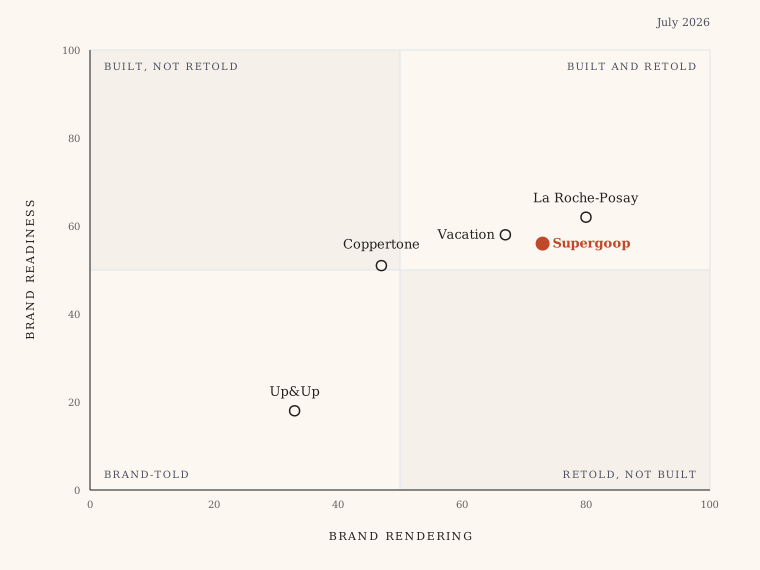
Brand Readiness × Brand Rendering for Supergoop (Sunscreen category), July 2026. Outside-in run, public evidence only.
Brand Rendering is the second-highest of the five sunscreen brands in this run, and Readiness is third. It is retold better than it is built to be retold, by the widest margin in the run.
What gets Supergoop retold is overwhelmingly one fact about one product: Unseen Sunscreen disappears on your face. Retailers, reviewers, users, and machines all say a version of it. It is a fact about a formulation, not about a brand.
Strengths. One claim survives every place it appears.
- More than 10,000 reviews sit behind the Unseen Sunscreen product across three retailers.
- It appears in a third of the answers we collected, 15 of 45, and was ranked first in six of them. Both are the highest in the run.
- Product titles are reliably used by retailers, as in “Unseen Sunscreen SPF 50 Invisible Sun Protection.”
- Two independent design publications analyzed the yellow-on-white packaging and the “-screen” naming system unprompted, and called both category-defining.
Weaknesses. In public the product exists and the brand does not.
- The name collides with Goop, and retailers write copy to tell the two apart.
- There is no English Wikipedia article and no Wikidata entry. Nothing in the machine-readable record says what Supergoop is or when it started.
- The brand replied to Reddit users in 2020 and 2021. The last reply we could find on its account is dated January 2021.
Observations
1. What gets retold is about the product
On retailer sites, the brand’s language survives. Product titles lead with the brand name, and the “invisibility” claim travels intact from the brand’s own site to every major retailer. In the forums, people run their own tests and report back, from a day at Universal Studios to a summer of Miami sun. Ask the three AI engines a category question and Supergoop is most likely to appear, more than any other brand we measured. In those answers, it is the lead suggestion answer six times, again more than any other brand. It appears on all three engines for daily wear under makeup, and leads the answer on two of them.
Supergoop takes the run’s only top mark on how well it attaches to questions asked of AI engines about the biggest category entry points, which is one of nine Readiness measures. Its Readiness score is still 56, third of five, because two other measures return nothing at all: whether the brand participates in the conversations about it, and whether it exists as a record that a machine can resolve.
2. The community is writing new brand language
Supergoop has authored plenty at brand and product level. A mantra, “Live Bright! Every. Single. Day.” A mission about daily protection and skin cancer. A published list of more than 1,600 excluded ingredients. A naming system that is clear and systematic: Unseen, Glowscreen, Mattescreen, Dewscreen, Lipscreen.
But in the forums we read, we found no one who repeated or retold the mantra, the mission, or the list.
What people wrote instead was about occasions that the brand never mentioned, like “face primer,” “slightly tinted primer,” “indoor sunscreen,” and “for work video calls.” The category now has language for wearing sunscreen at a desk, and regular people who use the product were the ones to write about it. We found no evidence that the brand has taken up any of this new language.
3. The most repeated thing anyone says about it points somewhere else
Price is the top objection in the community, and the community addresses the issue without talking about the brand. The highest-scoring comment in everything we collected was a 2022 post telling another user that Trader Joe’s makes a dupe of Unseen for $8.99.
It is notable that a four-year-old comment is still indexed and was the highest-scoring comment we collected. Asked in 2026 for the cheapest sunscreen that works, Google’s AI Overview returns Trader Joe’s Daily Facial Sunscreen and calls it a budget-friendly alternative to Supergoop’s Unseen Sunscreen. Supergoop is the brand that a cheaper product is measured against, a position no other brand in this run holds.
Hypotheses to explore
How long can a brand remain attached to a claim that other products can also make?
We suspect that Supergoop is cashing in on an early claim about invisibility. Supergoop is retold for one thing: Unseen Sunscreen disappears on your face. Sunscreens compete on that openly, and the engines field a standing question about which one leaves no white cast. Supergoop still takes the top answer on all three engines, even four years after its own community named a cheaper product that does the same job. A first claim on a category attribute can hold for a long time, but not forever.
Is the strongest connection between a brand and a category moment the one customers made on their own?
Brands build these connections deliberately, through advertising, retailer copy, and packaging, and those routes are repeatable and measurable. Supergoop has one it did not build. Its community created new usage occasions, attached them to this product, and worked out for themselves why it works well for those occasions. We suspect an audience-made connection is stronger than one more deliberately made, because nobody has to be persuaded to repeat it, and harder to hold, because nothing in it says where it came from. A brand that picks up an audience-made connection can keep it. A brand that only watches will cede that ground to other brands eventually.