Retellability TestSunscreen
Up&Up
Score
It scores 18 on Brand Readiness, a 0 to 100 scale for how well a brand is built to be retold by other people and machines.
It scores 33 on Brand Rendering, a 0 to 100 scale for whether it actually is being retold accurately and favorably, by those people and machines.
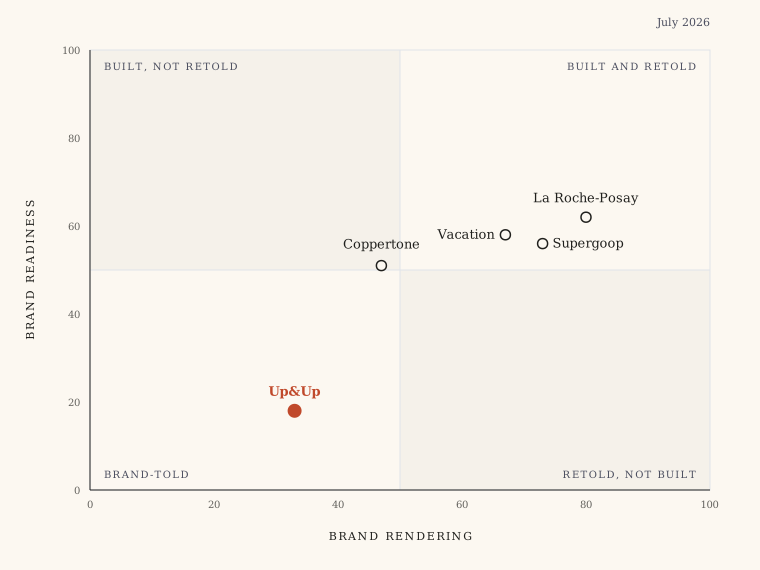
Brand Readiness × Brand Rendering for Up&Up (Sunscreen category), July 2026. Outside-in run, public evidence only.
Both scores are the lowest of the five sunscreen brands in this run, by a wide margin. Up&Up sits alone in the brand-told corner, where the telling is done by the brand and its owner rather than by other people. It is also the only one of the five brands measured that is a retailer’s private-label brand, which turns out to explain a lot about its position.
Strengths. The brand is chosen without needing to be talked about.
- The buyers who do find it are genuine advocates, recommending it to strangers unprompted as the cheap thing that works.
Weaknesses. It appears the brand produces nothing that a machine or a stranger can repeat.
- Across the 45 answers we collected, Up&Up appeared zero times, the only clean zero across the five brands we measured.
- It has no Wikipedia article or other structured data record, existing only as a subsection of Target’s page.
- Its name is spelled in different ways across its own materials, and is also a common phrase.
Observations
1. The brand is known only in a very small context
The people who buy Up&Up sunscreen like it. On Reddit, six of ten mentions are unprompted, offered to strangers as the cheap thing that works. They call it the Target store brand, the Target kids mineral one, or just cheap. They don’t spell it the same way every time, and its name is also a common phrase. Even the genuine positive conversation doesn’t appear to coalesce into anything firm for others to grab onto and retell.
We checked Wikipedia and Wikidata directly. There is no article and no entity record; the brand appears to exist only as a subsection of Target’s page. Asked plainly what Up and Up is, two of three AI engines returned dictionary definitions, and the one that found the brand listed it third, behind a Coldplay song. Even when asked what sunscreen to buy at Target, naming the store explicitly, Up&Up does not come up on any of the three engines. It didn’t appear in the answers to any of the other category and brand questions asked of the AI engines either; the only clean zero in the run.
2. Being a private-label brand is not a barrier
We could hypothesize that the reason it is not recommended, except in a small number of instances, is that private-label brands just don’t render. This is false. On the cheapest-sunscreen question, Google’s AI Overview recommended Trader Joe’s Daily Facial Sunscreen, which is also a store brand, also cheap, and also sold in only one chain. In fact, it won outright, while Up&Up wasn’t mentioned.
Google’s AI Overview described Trader Joe’s as a budget alternative to Supergoop’s Unseen Sunscreen. Up&Up had no comparable foil in any answer we saw.
In all, being a store brand does not appear to be a barrier. What separated the two brands in these answers was that one of them could be described against something better known.
3. Up&Up likely builds meaning where this test can’t see it
A Readiness score of 18 does not mean the brand builds no meaning. It likely builds plenty, in a place this diagnostic does not look. The arrow logo, shelf positioning, price points, and borrowed equity from the Target brand, all do real work at the point of purchase. This test measures a different route, where meaning is built by other people and machines talking about you. Up&Up barely participates there, and maybe it doesn’t have to.
Hypotheses to explore
What happens to a brand that's never had to introduce itself?
Target decides what's on its shelf, and Up&Up does well there, with its arrow, competitive price, and presumably good stocking and shelf placement. We found that its sunscreen buyers recommend it unprompted, by telling shoppers to go to Target, which is probably the most useful thing they can say. The sub-brand name doesn't matter so much in this context. But there's another set of AI shelves now, and Target isn't able to just hand out placements there. Across the 45 answers we collected, Up&Up was not mentioned once, and it was the only brand in the run that never showed up at all. A private label brand for another store brand did, though. The working hypothesis is that a brand gets on the AI shelf by being easy to name and easy to describe, without relying on a bigger "mothership" brand. A brand that's never had to do that kind of name recognition work starts a long way back from the rest of the field for this kind of query. Nobody yet knows how much of this category's shopping will end up happening there, of course.